|
C&O RAIL SERVICE
Largely forgotten is that from September 6, 1891, to November 2, 1970, travelers could purchase a ticket to reach Hot Springs and the Homestead by train. Before this, travelers had to journey long distances to Covington or Millboro and then continue to the Baths by horse-drawn coach. It is recorded that "The best families came every year in their own carriages, with their servants, and stayed all summer". Melville E. Ingalls who was President of C&O Railroad until 1900 had purchased the property with a group of investors in 1892. Reportedly he found the already popular mineral springs while surveying for a new rail line in 1881 and realized the its potential as a luxury destination. The C&O junction in Covington soon included the Hot Springs Branch which ran 24 miles to terminate at a train platform near the spa. The result was that tourists could take Pullman sleeper service from cities such as DC, Richmond, Cleveland, Chicago, and Detroit to Bath County. The final leg involved transferring in Covington to a train bound for what would later become Hot Springs. In other words, from any city on the C&O network one could conceviably reach the Homestead with only a single transfer. 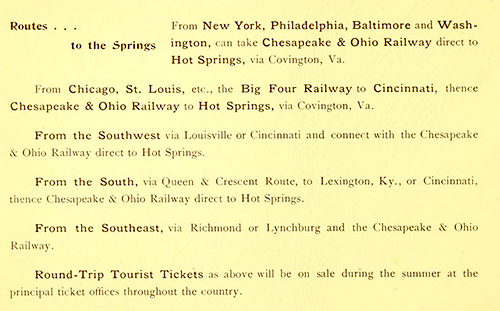
The Virginia Hotel sat next to the platform while a covered walkway allowed travelers to walk directly from the train to their rooms. The mineral baths were only a short walk away, while the Homestead Resort was steadily taking shape across the street. However, two problems plagued the Virginia: limited views of the surrounding area and complaints that coal soot from the train was seeping into the rooms. By 1920 the hotel was repurposed as an employee dorm and offices. BELOW: the Virginia Hotel and train in 1893. 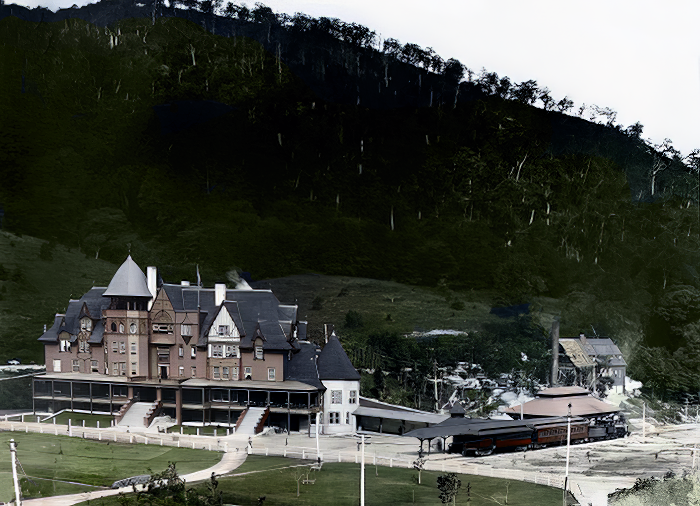
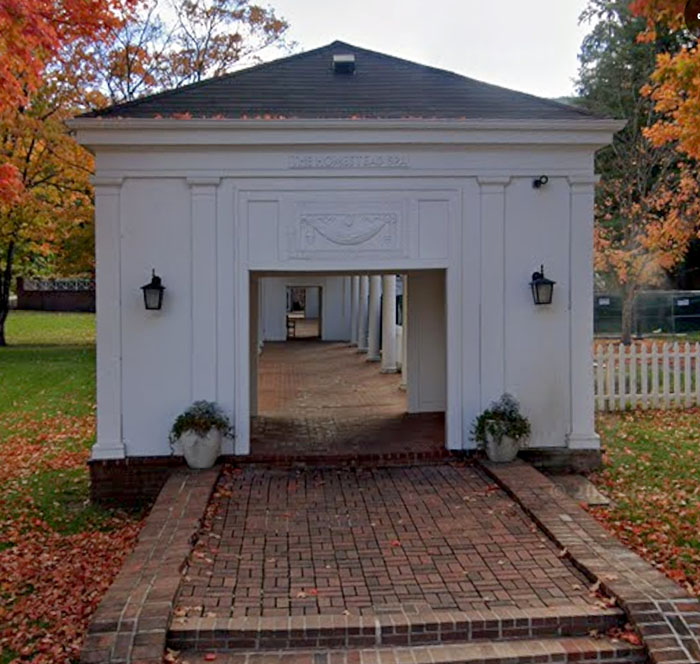
Having a dedicated train line directly to Hot Springs was fortunate for the Homestead because the 1920-30s became a very popular time for luxury rail travel in the US. Examples were The Pocohontas from Cincinnati to Virginia Beach, the 20th Century Limited to NYC, and the Orange Blosson Special to Miami. Offering sleepers, dining and observation cars, rail travel had become a glamorous way to travel before the advent of the interstate road system. Honestly, taking a sleeper service journey that ended at an exclusive mineral-spring resort in the mountains of Virginia must have been unforgettable. Branch-Line schedules tend to use numbers instead of proper names to identify a train and the Homestead line was said to be train number 310. Functioning as a "Mixed Train" it carried both passengers and freight to Hot Springs. A Mixed Train is used to serve rural communities when passenger demand was too low to justify a dedicated passenger train. This was understandable, given the large quantities of food and supplies required to sustain the resort. Steam engines were gradually retired and replaced by diesel locomotives in the early 1950s. This image from 1967 shows C&O GP7 #5894 diesel engine at the platform. Note the white building on the far left. 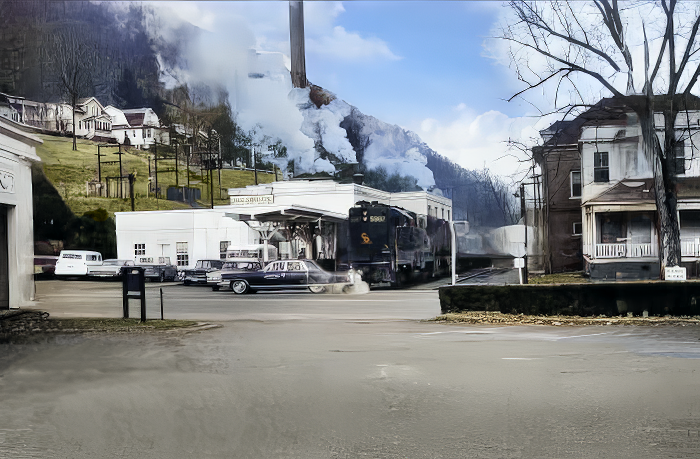 Courtesy Bath County Historical Society Today, still sitting on the opposite side of the street from the old Virginia Hotel is a long colonnade with "The Homestead Spa" visible above the entrance. The brick sidewalk marks the route that decades of passengers walked from the Virginia Hotel and train to the baths at the far end. The colonnade was constructed in the 1950s and was flanked by a swimming pool and sunning area.
|
Datsunzgarage.us 1997-2026 |